Clinical information & cohorts
Organize facts, times and sources around a research question. Distinguish recorded, unrecorded and unconfirmed information.
 RESEARCH &
CLINICAL INTELLIGENCE
Research and development around clinical information, domain knowledge and evidence organization. Turn scattered information into traceable material for professional discussion and review.

Make the evidence visible. Identify gaps. Keep judgment with clinicians and researchers.
Organize facts, times and sources around a research question. Distinguish recorded, unrecorded and unconfirmed information.
Connect domain concepts, knowledge sources, rule versions and conditions of use for expert review and maintenance.
Bring candidate findings, evidence, conflicts and gaps into one workflow. Record confirmation, rejection and requests for more information.
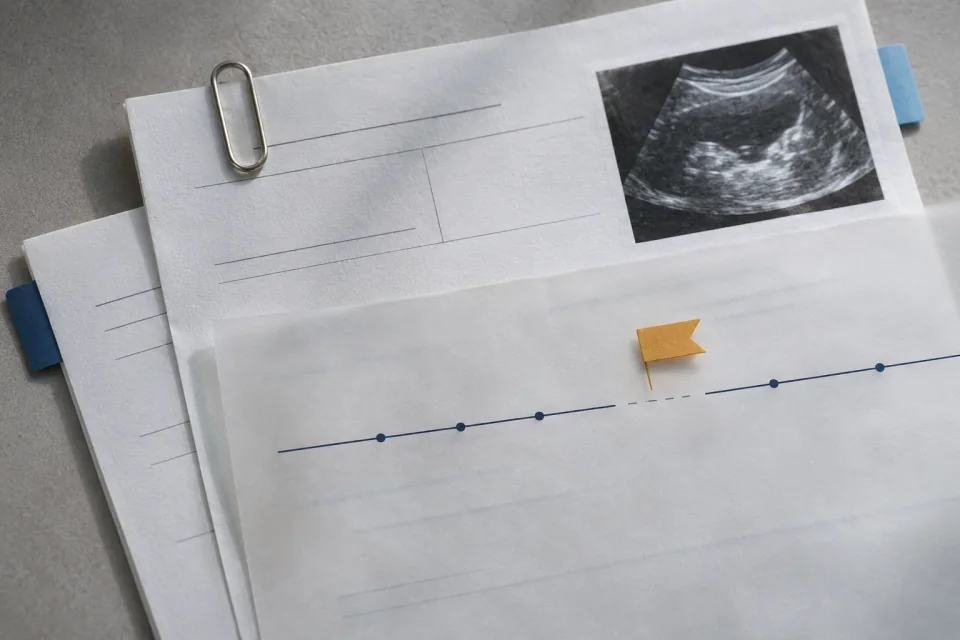
Consider a clinical record awaiting review. AI aligns examination records on a timeline, flags missing or conflicting information, and shows the applicable rules and their evidence for a clinician or researcher to check.
Illustrative workflow. Data scope, knowledge sources and use must be agreed within each project.

Define the purpose, users, available data and review process before designing evaluation cases.
We examine whether evidence can be traced, missingness is preserved, rules apply and professionals can understand and correct outputs.
This page describes research, development and methods. Clinical use depends on project validation scope; AI output does not replace professional clinical judgment.
Explore the clinical demoWhere authorization, quality and applicability are established, we can assess how wearable or other health records could be organized into longitudinal material for clinician review. Device connectivity, metric meaning and use require separate validation.
Authorization, data formats, quality and interfaces must be assessed first. Universal plug-and-play access is not assumed.
The public website uses synthetic demonstrations. Other materials depend on authorization and cooperation arrangements.
Bring a specific research or workflow question. Discuss data conditions, knowledge sources, review roles and evaluation scope.
INSPECT THE WORKING DEMONSTRATIONS
Follow source discovery, compare coverage and test a versioned knowledge dependency.
Watch the English walkthrough →CLINICAL SOFTWARE / 78 SECONDSInspect inputs, explanations and sources while preserving missing and conflicting information.
Watch the English walkthrough →LET’S START A CONVERSATION
Start with the question, data and responsibilities. Define the evaluation scope together.
Discuss a use case